
Senate Armed Services Committee Hearing Intensively Presses on Exclusion of Opposition Party from Classified Briefings and Budget Opacity
Republican Senator Rounds Also Warns: “Excluding Democrats Will Hinder Bipartisan Defense Budget Passage”
Compounded by Budget Deficits, Iran Response, and Sailor Welfare Controversies, a Rocky Road Ahead for Senate Confirmation
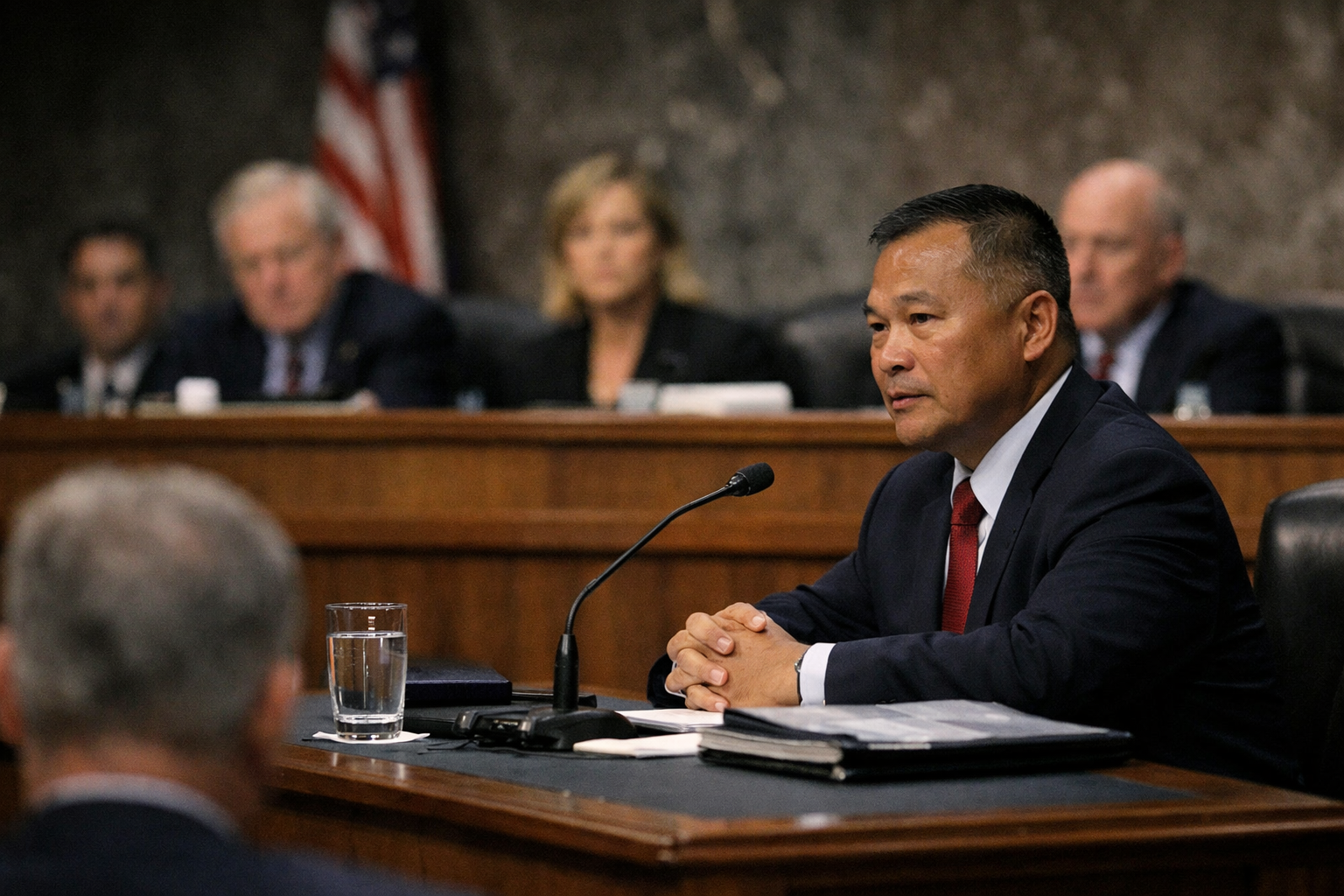
Acting Secretary of the Navy Hung Cao, an Asian American Republican politician from Virginia awaiting formal confirmation as Secretary of the Navy, bowed his head under heavy bipartisan fire from lawmakers over a lack of communication with Congress and administrative dysfunction during his Senate confirmation hearing.
The Senate Armed Services Committee held a confirmation hearing for nominee Cao on the 17th, intensively scrutinizing his job performance and communication methods over the past seven months as acting secretary.
During the hearing, criticism erupted from both the opposition and within the ruling Republican Party regarding the repeated exclusion of Democratic lawmakers from classified briefings.
Senator Mike Rounds (R-SD) pointed out, “Are you aware of the fact that our Democratic colleagues have repeatedly not been invited to classified discussions?” adding, “If you do not share critical security threat information at the top-secret level and above with the opposition party, we will be left with no choice but to rely solely on Republican party-line votes, such as through budget reconciliation in the future.”
The Trump administration has currently allocated a record $1.5 trillion for the fiscal year 2027 defense budget. Although this comprises $1.15 trillion in discretionary spending combined with an additional $350 billion via the budget reconciliation process, its passage remains uncertain as congressional processing has reached a deadlock. Senate Republican Majority Leader John Thune is also avoiding giving a definitive answer on whether he will pursue a standalone defense reconciliation bill.
Senator Rounds pressed further, stating, “If the reconciliation bill falls through and we have to rely on a supplemental budget, a bipartisan supermajority of 60 votes will be essential for Senate passage. It is difficult to ask for 'yes' votes from opposition members who were not even given the information. Give us a firm commitment to return to the principle of bipartisan information sharing when it comes to national security matters.” In response, nominee Cao promised transparent communication that includes both parties going forward.
Criticism also continued regarding the transparency of budget execution and his leadership under the acting administration.Senator Jeanne Shaheen (D-NH) pressed the nominee on the lack of disclosure regarding a $65 million budget deficit at the Portsmouth Naval Shipyard.
In response, Cao struck a humble tone, saying, "To be completely candid, Senator, I failed you. I committed to getting you an answer, and I did not deliver. Following this hearing, within a week, I will find out exactly what happened and report back."
Cao, who has served as acting secretary since April following the dismissal of his predecessor, John Phelan, amid clashes with Defense Secretary Pete Hegseth and other top Pentagon leadership, also faced sharp criticism over various issues that arose during his tenure. Democratic lawmakers closely scrutinized the handling of the response to the conflict with Iran, extended ship deployments, poor living conditions aboard vessels deployed to the Middle East, and the deteriorating mental health of sailors, including a series of suicide attempts aboard aircraft carriers.
Shaheen delivered a blunt assessment, saying, "I have serious questions about your decision-making, your willingness to speak truth to power, and your commitment to transparency with Congress."
For Cao, who retired as a Navy captain in 2021, to assume the post of Secretary of the Navy under the principle of civilian control, he must also secure a special waiver approved by both the Senate and the House of Representatives to bypass the requirement of a seven-year waiting period following military discharge. Compounded by past controversy over his remarks during the 2024 Virginia U.S. Senate race—where he asserted that the military needs "alpha males" and "alpha females" to win wars—he is expected to face a difficult path toward full Senate confirmation, which requires Democratic cooperation.