
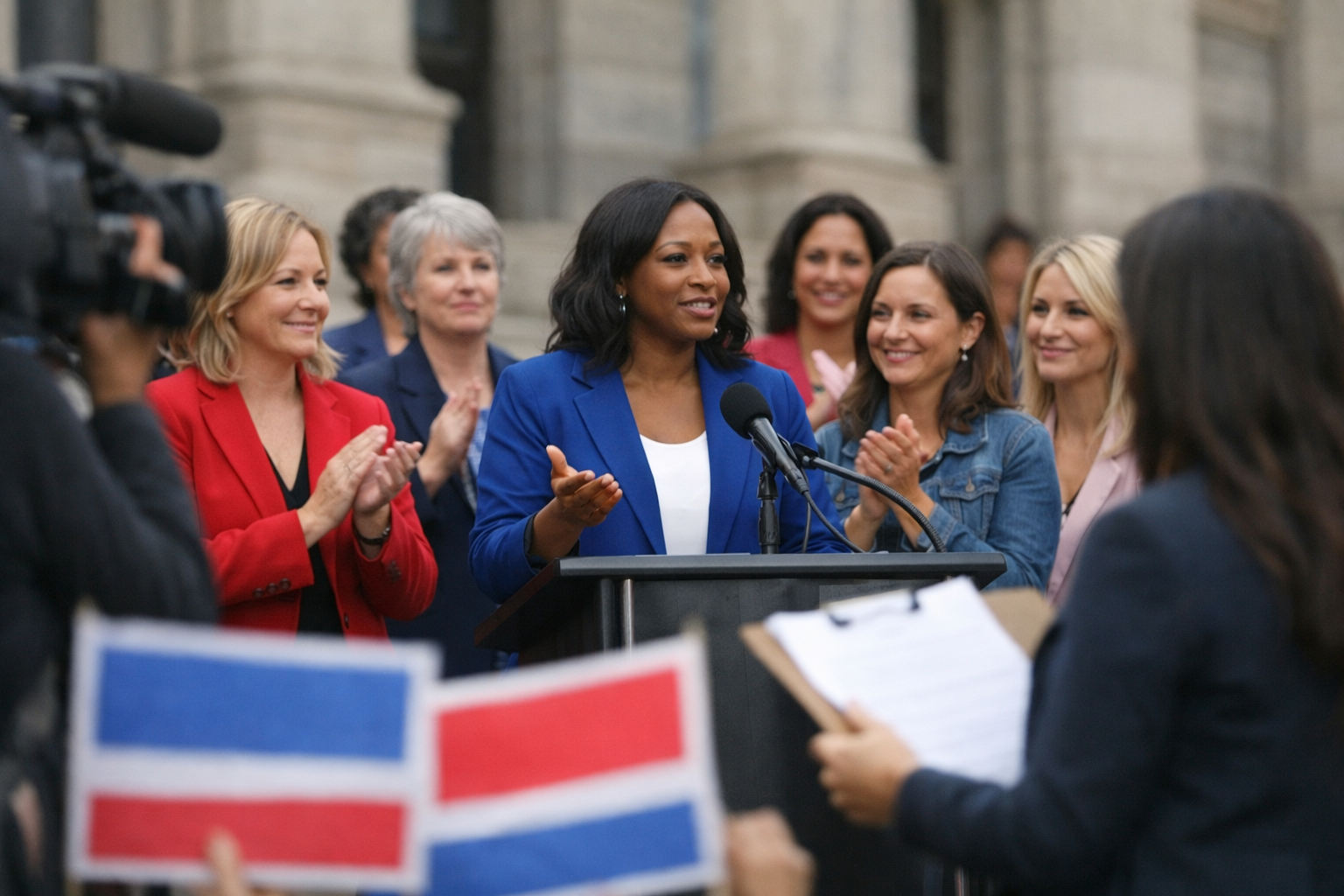
Ahead of the U.S. midterm elections to be held in November, the number of female candidates running for state seats across the country has reached an all-time high, heralding a strong “female wind” in U.S. politics. While more than one in three candidates are women, more than two-thirds of the candidates are members of the Democratic Party, so overcoming gender imbalance between political parties has emerged as a new challenge.
According to the latest count by the Rutgers University Center for American Women and Politics (CAWP), this year's state legislators A total of 3,824 female candidates ran for office in 46 states across the country where elections were held. This number exceeds the previous record of 3,621 in 2022, and the proportion of women among all state legislative candidates in this election cycle reaches 35.5%.
Currently, the proportion of women occupying about one-third of state legislative seats across the United States is an all-time high, but it is still far from complete gender balance (parity).
CAWP Director Debbie Walsh said, "Some elections are held by women. “Although there is a sharp increase in the number of women running for office in each cycle, gradual progress continues from a long-term perspective,” he said. “It is a meaningful step toward political change, but not everything changes in just one election, and the American political system itself is structured to bring about such slow and steady change.”
In particular, the gap between political parties is still at a serious level. Of the female candidates who confirmed their nomination this year, 68% belong to the Democratic Party, and among all female lawmakers currently serving in the state legislature, the Democratic Party accounts for about 64%.
Director Walsh said, "To achieve true gender balance in Congress, it is impossible to elect only Democratic female lawmakers, and a large-scale effort at the Republican Party level is essential," adding, "For women to exercise real political power, they must enter Congress evenly from both parties." Emphasized.
Across the political world, women's political ambition is found to be lower than that of men. According to research results, women tend to underestimate their own qualifications, have a high level of resistance to competition, and are less likely to receive recommendations or support to run for office than men. In addition, the majority of states have adopted a 'part-time state legislature' system, so running for office itself is a huge practical barrier for women who have to work full-time and act as primary caretakers.
For the Republican Party, the situation is more complicated.Experts analyze that the Republican Party is in a political environment this year where it must focus on defense, as well as the lack of organized support for female candidates and resistance to identity politics, which have all acted as factors preventing conservative women from entering politics.
Nevertheless, according to government relations consulting firm MultiState, the number of female lawmakers in state legislatures has increased by about 40% over the past 10 years. However, regional differences are extreme. In Colorado, Nevada, and New Mexico, female lawmakers occupy more than half of all seats, while in West Virginia, South Carolina, and Mississippi, the proportion is less than 15%.
This election is evaluated to be similar to the 2018 election, when a large number of female candidates entered politics during the midterm elections of President Donald Trump's first term. As at the time, the current political trend toward the Republican Party is worsening, raising the possibility that not only the leadership of Congress but also hundreds of state legislative seats will be transferred to the Democratic Party.
Midterm elections traditionally tend to be unfavorable to the ruling party. In addition, there is analysis that the issue of 'affordability', which has recently emerged as the biggest topic of national affairs, is creating an advantageous terrain for female candidates.
Republican opinion poll expert Amanda Iovino, a consultant, explained, "While male voters and candidates look at the economy from a macro perspective, such as income, wage growth, job creation, and investment performance, women have approached it in terms of actual living costs such as household budget and shopping cart prices." He went on to say, "When perceived prices emerge as the top issue rather than the overall economy, a candidate who can instinctively deal with the cost aspect is at an advantage." He added, "You can teach these language skills to male candidates as well, but it is much more naturally ingrained in female candidates."
Candidate Stephanie Board (Democrat), a former teacher running for the Texas House of Representatives, also emphasized that women can convey these people's livelihood issues in a much more sincere way. “They are at the forefront of managing their families and maintaining daily lives,” he said, adding, “We know better than anyone else what problems bills passed without women’s participation cause in the field.” He, who entered politics through volunteer work for the gun control group Moms Demand Action, added that women's willingness to run for office has increased after the Supreme Court's 2022 ruling to abolish abortion rights.
He said, "Especially in Texas, women are feeling deep disillusionment and fatigue over the reality that my two daughters do not even have the rights I had."Candidate Bode is facing an uphill battle against former Harris County Clerk Stan Stanart, who is supported by Republican Gov. Greg Abbott, in a conservative district near Houston, but he expressed confidence that he can overturn this election.
Candidate Bode's campaign is supported by 'The First Ask,' a political action committee (PAC) that supports Democratic female candidates advocating for abortion rights across the country. This organization is focusing on building a sustainable political infrastructure, going beyond the phenomenon of a temporary influx of female candidates only during times of political upheaval.
CEO Caroline Wells mentioned the case of Nevada, where in 2018, for the first time in U.S. history, female lawmakers took over the majority of the state legislature, and said, "The goal is to create a structure where women continue to win, like in Nevada." He added, "Female lawmakers have a high rate of passing bills, are active in compromise with the other party, and tend to focus on legislation that will actually benefit the family." He added that he expects the Republican Party to produce more female politicians.
The Republican Party is also making efforts to recruit female talent. The 'Republican State Leadership Committee (RSLC)', which supports the election of conservative state legislators, has been operating the 'Right Leaders Network', a program to discover female candidates, since 2021, and has produced 67 female state assembly candidates in 12 states this year.
Consultant Iovino said, "It would have been difficult to actively recruit new female, minority, or meritorious candidates in a difficult situation like this year where the supermajority party must protect seats. He predicted, "Based on the record of Republican women running for office in 2020 and 2022, the work to replenish the female talent pool in the future election cycle will begin in earnest."
Meanwhile, in Georgia, women's political participation this year is hotter than ever. Melita Easters, head of the Georgia WIN List, a Georgia women's legislative support group, said, "A record-high 127 women ran in this year's Georgia state assembly elections, and we officially supported 76 of them." “I have the capabilities and experience in solving complex problems created by generations of men,” he emphasized.
Democratic candidate Michelle Schreiner, who is running for the Georgia House of Representatives, confessed that she went through serious consideration before deciding to run. The psychologist and researcher is challenging Sharon Cooper, a Republican who has held the seat outside Atlanta for 29 years.
Candidate Schreiner said, "I only raised my hand after being asked to run three times," adding, "The decision to run was a heavy decision that had a real impact on my family, including campaigning on my birthday and having to miss my daughter's soccer game and my son's baseball game."He expressed his ambition to provide new options to residents, saying, "It is not simply a challenge to an incumbent lawmaker, but an expression of the willingness to work with gratitude and a sense of service to the community."