
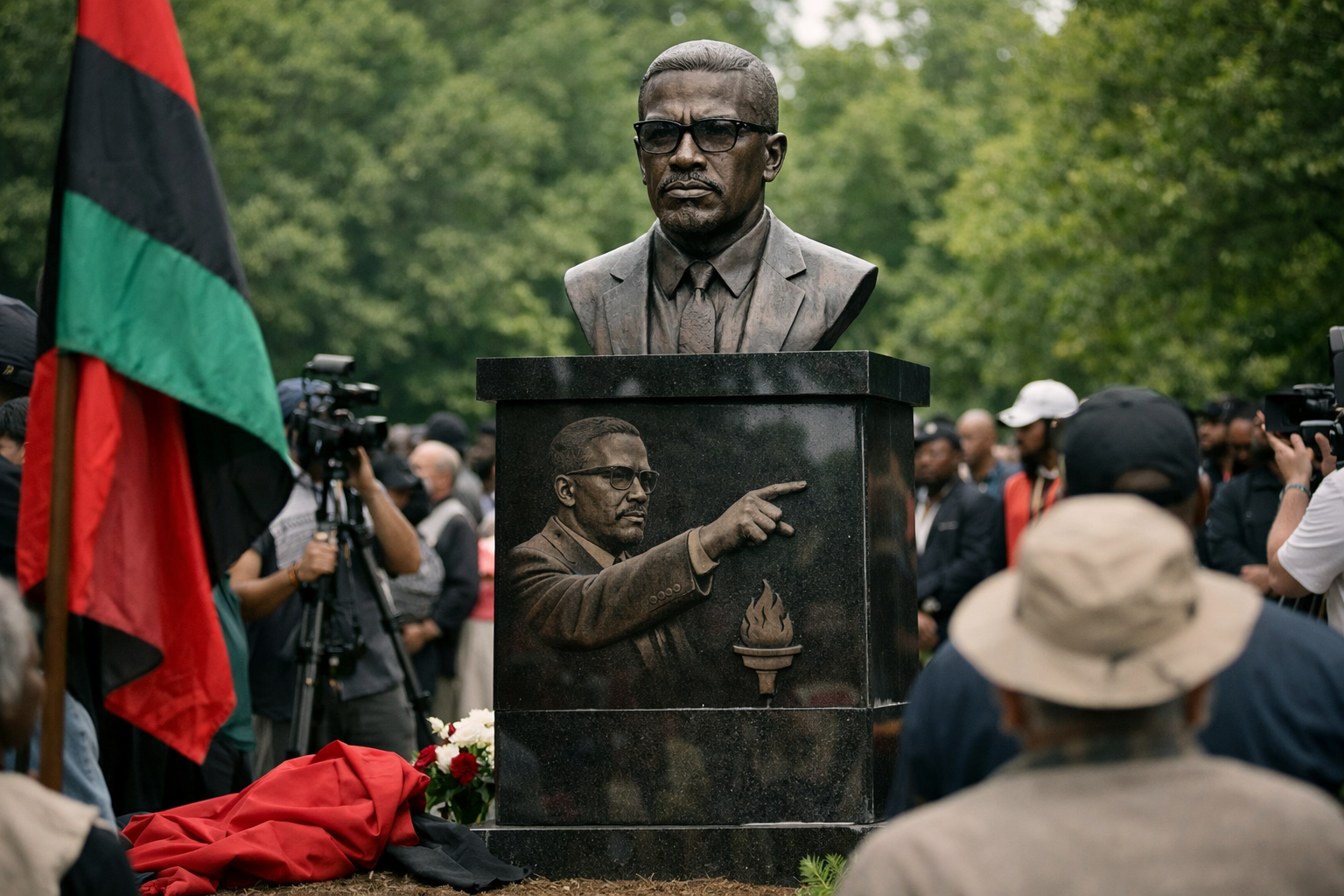
An official memorial honoring Malcolm X (1925–1965), a titan of the Black civil rights movement who left a profound mark on 20th-century American history, has been newly unveiled in Anne Arundel County, Maryland. This marks the first memorial in the state of Maryland established to honor a Muslim American.
On the 14th, an unveiling ceremony for the Malcolm X memorial took place in the plaza outside the Michael E. Busch Library in Annapolis, Maryland, with about 100 attendees, including political and government officials as well as local residents. Crafted as a double-sided monument, it is inscribed with key photographs and historic quotes providing an overview of his life. It illuminates his turbulent journey, capturing moments alongside the Rev. Martin Luther King Jr. and former world heavyweight champion Muhammad Ali, up to the tragic moment of his assassination in February 1965.
The project was spearheaded by the African American Leaders Caucus. Of the total $350,000 cost, the county government contributed $70,000, with the remainder funded by voluntary donations from private organizations and citizens.
Although Malcolm X had no direct ties to Maryland, the value of his legacy is regarded as transcending regional boundaries. Maryland State Senator Shaneka Henson (D-Anne Arundel) remarked on the significance, saying, "Placing a memorial to Malcolm X at a library is deeply meaningful. He was a great storyteller who documented his own history and passed it down to future generations, and the record he left behind continues to inspire generations today."
Addressing mixed perspectives from some quarters, local leaders emphasized a message of "growth and change." Anne Arundel County Executive Steuart Pittman stated, "Growing up, I was taught that Dr. Martin Luther King Jr. was the 'good' figure and Malcolm X was 'somewhat scary,' but as I grew older, I came to understand the multifaceted depth of his life. While some residents may feel discomfort, this monument will serve as an opportunity to broaden public perspective and encourage historical reflection."