
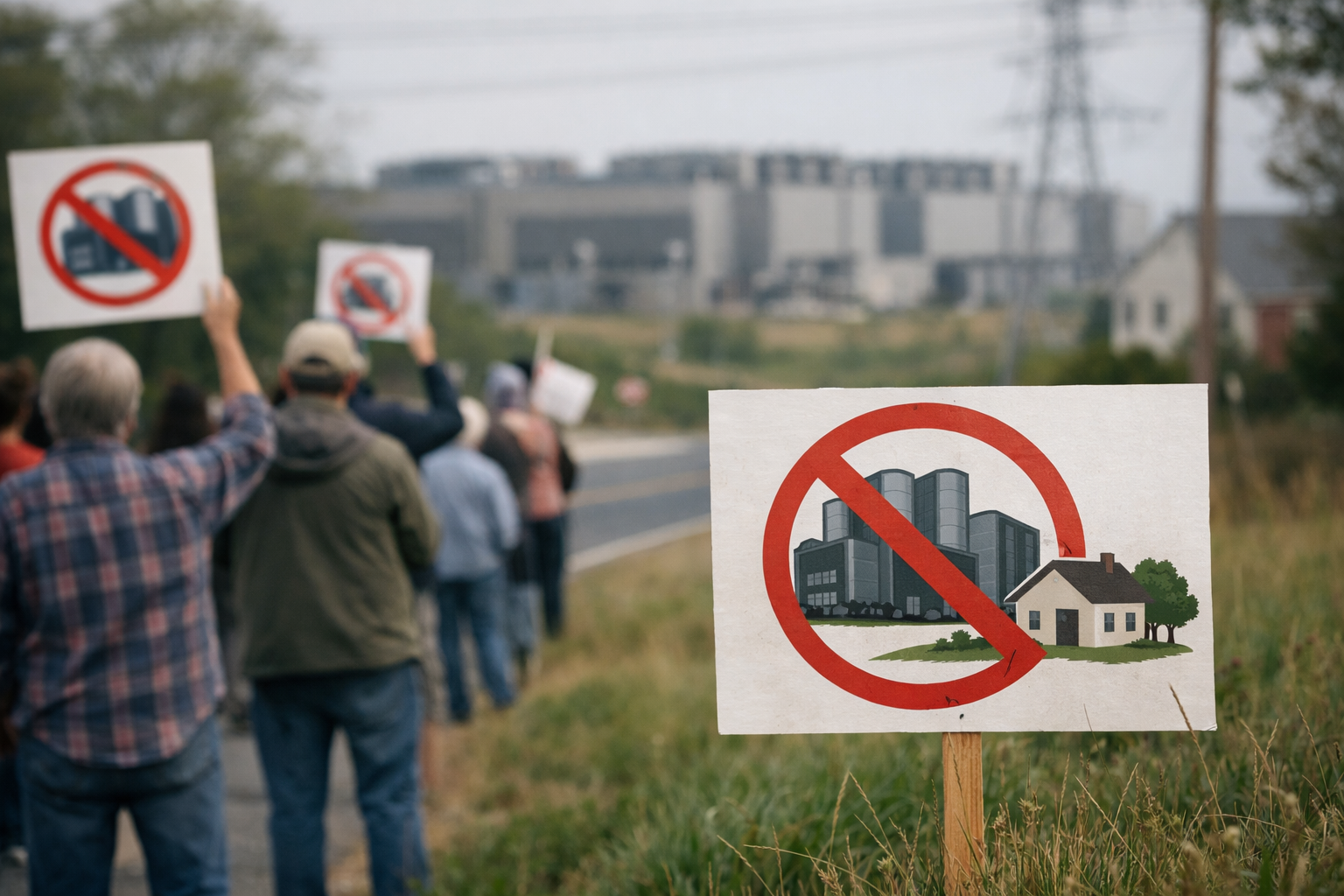
- UMBC Poll: 80% of Voters Oppose Data Center Construction
- Concerns Over Rising Power and Water Rates, Environmental Damage; Cool Reception for AI Technology
- Governor Wes Moore's Approval Rating Stagnates at 49%; Holds Lead for Reelection Amid Economic Anxiety
Politicians' calculations regarding data center attraction and artificial intelligence (AI) industry development have hit a major obstacle in the form of fierce resident pushback.
Eight in ten Maryland voters strongly oppose the construction of data centers, both statewide and within their own local communities. As concerns over rising electricity rates and environmental pollution outweigh expectations for technological innovation, efforts to expand core infrastructure for the AI industry are facing severe headwinds.
According to a survey of 776 registered state voters likely to vote, conducted and released by the Institute of Politics at the University of Maryland, Baltimore County (UMBC), public opposition to data center construction was widespread across all regions.
When half of the respondents were asked for their opinions on building data centers anywhere in the state, and the other half were asked about construction near their homes, an overwhelming majority of nearly 80% in both groups expressed opposition.
Mileah Kromer, director of the UMBC poll, noted, "The most striking finding is that residents don't just oppose it in their own backyards (NIMBY), but anywhere in the state of Maryland. Regardless of site conditions, there appears to be a fundamental rejection of hosting them within the state."
Underlying this negative public opinion are concerns over a tangible decline in quality of life. A majority of respondents anticipated that data centers would inevitably lead to increased household electricity and water bills, degraded water and air quality, and an overall deterioration of the living environment.
Residents also reacted cynically to claims from proponents that data centers will revitalize the local economy, increase tax revenue, and create jobs. Nearly half of the respondents said the impact of data centers on the state's economy and tax revenues would be negative, while negative outlooks on job creation (37%) outweighed positive ones (26%). Furthermore, only 23% of respondents believed that AI technology itself would have a positive impact on society, confirming a deep skepticism toward advanced technology as a whole.
Meanwhile, the poll showed that Maryland Governor Wes Moore, a Democrat, holds a 49% job approval rating. This is virtually unchanged from the 48% recorded in an April survey, indicating that his job performance evaluation remains flat despite pervasive economic dissatisfaction among residents. Moore's disapproval rating stood at 42%.
Maryland residents' perceptions of the state's economy remain quite bleak. Asked whether the state is heading in the right direction, 49% of respondents said it is on the 'wrong track,' outnumbering the 37% who said it is on the 'right track.' Additionally, 81% rated current economic conditions as 'poor' or 'fair,' while only 17% rated them as 'excellent' or 'good.'
In evaluating economic conditions, voters specifically pointed to prices of everyday goods and services (94%), personal financial situation (90%), housing costs (86%), and state taxes and fees (84%) as major factors, indicating that high inflation and the burden of housing costs are central to the public's discontent.
Political experts diagnosed that nationwide economic headwinds, such as high inflation and interest rates, are acting as stumbling blocks preventing the governor's approval ratings from rising. Todd Eberly, a political science professor at St. Mary's College, explained, "Gas prices, energy costs, and an inflation rate around 3% are structural issues affecting the entire nation, not just Maryland. Voter dissatisfaction is less an issue isolated to state government and more a reflection of broader national economic anxiety."
Nevertheless, Governor Moore is not expected to face major hurdles in his upcoming reelection campaign this November. Given Maryland's political landscape, where more than half of all registered voters are Democrats, Governor Moore still maintains a wide lead of more than 20 percentage points over Republican nominee Dan Cox. Although Governor Moore took office in 2023 with an overwhelming 64% approval rating, the gap between his positive and negative ratings has narrowed to about 7 percentage points.